
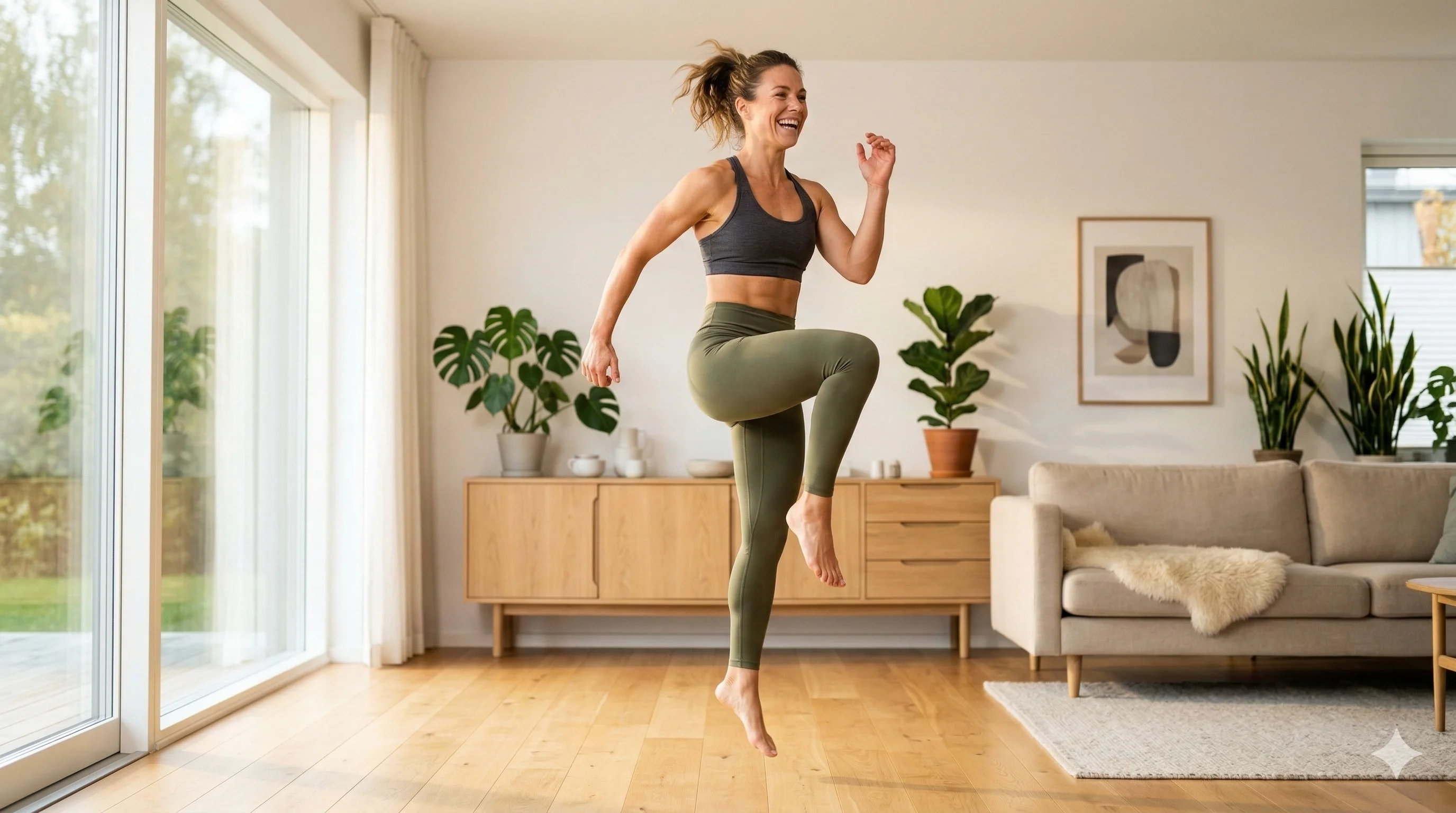
A dynamic cardio exercise that mimics running in place with knees driven high. High knees intensely work the hip flexors and core while spiking your heart rate within seconds.
Execution
Stand with feet hip-width apart, arms bent at 90° as in a sprint position. Drive one knee up to hip height (thigh parallel to the floor or higher) while pumping the opposite arm forward. Plant your foot and immediately drive the other knee up. The movement is fast and dynamic, like high-frequency running in place. Stay on the balls of your feet, torso slightly forward and abs engaged to stabilize the pelvis.
Breathing
Breathe rhythmically and shortly, as in a sprint: two counts in, two counts out. Avoid holding your breath, even as intensity rises.
Benefits
- •Explodes your heart rate in seconds — perfect for high-intensity intervals
- •Strengthens hip flexors, a key muscle group for running and daily mobility
- •Works arm-leg coordination and dynamic proprioception
- •Strongly engages core stability to stabilize the pelvis with each knee drive
- •Improves foot speed and muscular reactivity in the lower limbs
Variants
Butt kicks
Instead of driving your knees up, your heels kick back toward your glutes. Targets the hamstrings and calves more while reducing stress on the hip flexors.
Our tips
- 1.Drive knees to at least hip height — below that, the exercise loses its purpose
- 2.Keep your torso upright or very slightly forward, not leaning back
- 3.Use your arms actively: they set the rhythm and help drive the knees
- 4.Start at a moderate pace and progressively increase speed over the first few reps
Common mistakes
- •Knees not rising high enough — the thigh must reach parallel to the floor for effective hip flexor work
- •Torso leaning back to compensate — a sign of weak hip flexors. Reduce speed and keep the core engaged.
- •Landing on your heels — stay on the balls of your feet to protect your joints and maintain dynamism
- •Arms still at your sides — opposite arms must accompany the movement for coordination and balance
- •Too fast a pace at the expense of range of motion — better to drive high and go slightly slower than to shuffle with no amplitude