
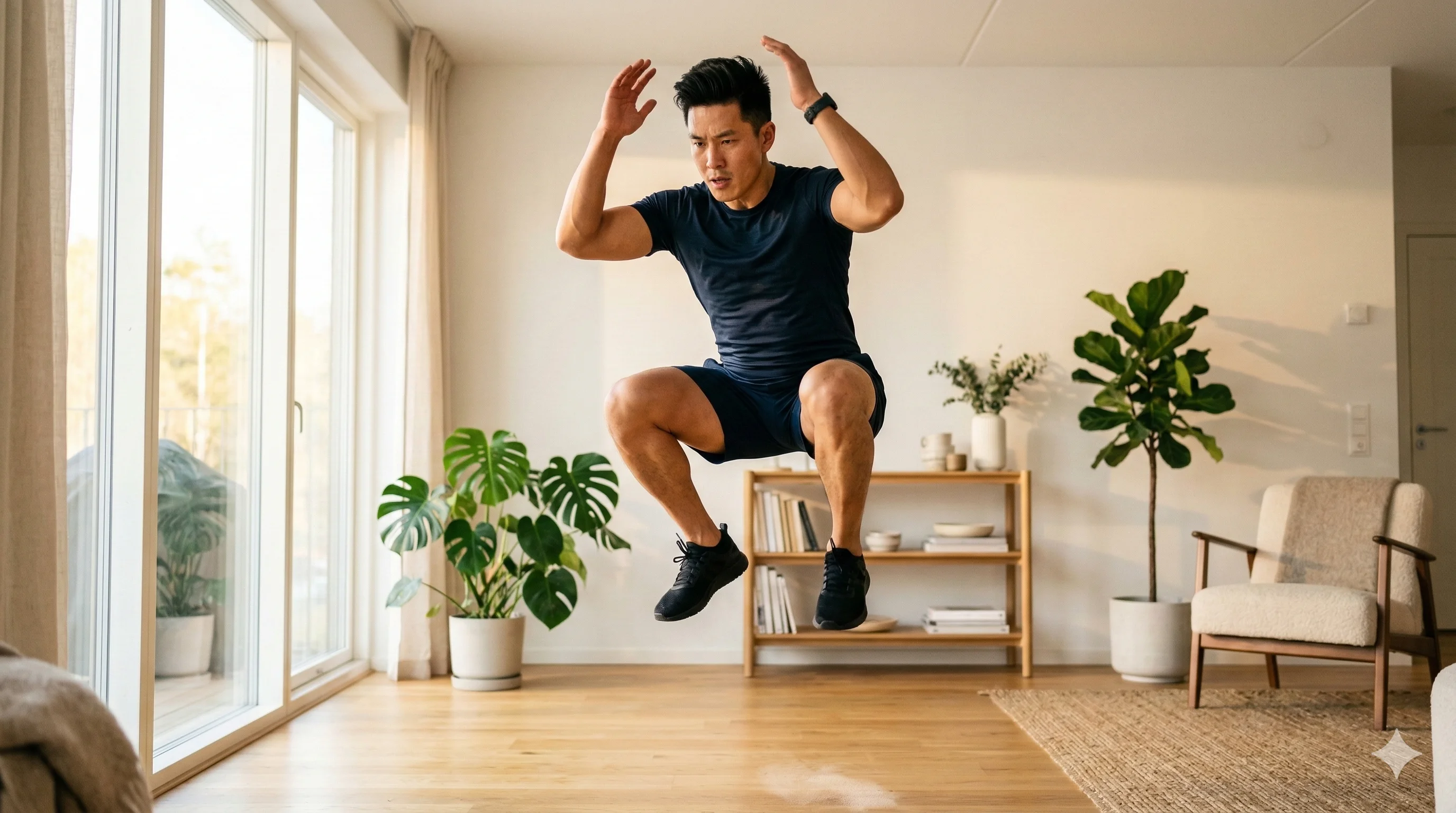
The king of lower-body movements. The squat is a fundamental motor pattern that engages the entire lower chain: thighs, glutes and core. It's the movement you perform every time you sit down and stand back up.
Execution
Stand with feet shoulder-width apart or slightly wider, toes turned out 15–30°. Initiate by pushing your hips back as if sitting into a chair. Lower while keeping your weight through your heels and mid-foot, knees tracking over your toes. Descend at least until your thighs are parallel to the floor (deeper if your mobility allows). Drive through the floor to rise, squeezing your glutes at the top.
Breathing
Inhale deeply on the way down (belly expands), exhale forcefully on the way up. For heavy or intense sets, take a breath before descending and exhale past the sticking point on the way up.
Benefits
- •Strengthens the entire lower body: quads, glutes, hamstrings
- •Improves hip, knee and ankle mobility
- •An essential functional movement: sitting, standing, carrying loads
- •Strongly engages core stability to keep the back straight
- •Triggers a significant hormonal response due to the large muscle mass involved
Variants
Sumo squats
Feet very wide, toes pointing out. Targets the inner thighs (adductors) and glutes more. Easier on ankle mobility.
Pulse squats
Stay in the bottom position and perform small bouncing movements. Increases time under tension and burns out the quads.
Jump squats
Add an explosive jump at the top. Develops power and cardio. Reserved for those without knee issues.
Assisted pistol squat
Single-leg squat holding onto a support. Works balance, unilateral strength and mobility. An advanced goal to build gradually.
1.5 squats
Full descent, rise halfway, descend again, then rise completely — that counts as one rep. Greatly increases time under tension in the bottom portion of the movement.
Pop squats
Jump to spread your feet into a wide squat, then jump to bring them back together. Combines cardio work and leg strengthening in a dynamic, rhythmic movement.
Goblet squat (no weight)
Hands clasped in front of your chest, elbows pushing between your knees at the bottom. Helps keep the torso upright and deepen the squat — an excellent technique correction tool.
Sissy squat
Lean your torso back, push your knees forward, heels off the floor. Intensely isolates the quads. An advanced movement requiring good balance and healthy knees.
Wall sit
Back flat against a wall, thighs parallel to the floor, held isometrically. A pure endurance challenge for the quads — deceptively simple, brutal after 30 seconds.
Our tips
- 1.Push your knees outward on the way down — they must never cave inward
- 2.Keep your weight through your heels: you should be able to wiggle your toes at any moment
- 3.Back stays straight, chest tall and proud. Imagine you're wearing a logo on your chest that everyone should see
- 4.Go at least to parallel thighs — quarter squats develop neither strength nor mobility
Common mistakes
- •Knees caving inward (valgus) — consciously activate your glutes to push your knees out
- •Heels lifting off the floor — a sign of limited ankle mobility. Work on mobility or place a small wedge under your heels
- •Torso collapsing too far forward — strengthen your upper back and core. Try goblet squats to correct this
- •Insufficient depth — going only halfway robs the movement of its main benefits
- •Excessive speed — control the descent (2–3 seconds) before rising dynamically